2026 Year-End Tax Planning: How to Keep Your Tax Strategy Aligned with Your Financial Plan
Oct 13, 2026
Oct 13, 2026

By Matt Rice, CPWA®, CFP® and Drake Thatcher
Higher standard deductions, expanded State and Local Tax (SALT) deductions, limitations on itemized deductions, and new charitable giving provisions can potentially change several year-end planning decisions heading into 2026.
The One Big Beautiful Bill Act changed several rules that may directly affect how many individuals and families approach tax planning beginning in 2026. The legislation introduces several tax provisions that may affect taxpayers differently based on their individual circumstances, income sources, deductions, and planning decisions. Here are several areas worth reviewing with your IMA Private Wealth advisor before year-end.
The higher state and local tax (SALT) deduction puts deductible state tax payments back into focus for many households. While the benefit may be reduced or eliminated at higher income levels, taxpayers should revisit the timing of deductible state tax payments and how those payments can affect their itemized deductions.
A deduction does not necessarily produce a tax benefit equal to your highest federal tax rate. New limitations may reduce the value of itemized deductions for certain taxpayers. Some deductions may not produce the same tax benefit they did under prior law. Before accelerating mortgage interest, state tax payments, or charitable gifts, we suggest estimating how much tax savings the deduction can provide.
Tax planning is not always about reducing taxable income. In some cases, individuals may consider recognizing income while current tax rates are relatively low rather than waiting until required minimum distributions or other income sources can push income into higher brackets.
A year-end projection may help determine how much room remains within a particular tax bracket and whether it makes sense to recognize additional income. A Roth conversion is one option, but it is not the only one. Withdrawals from IRAs and other retirement accounts may also be used to fill available room within a lower tax bracket.
Future tax rates, retirement income needs, Medicare premiums, and estate planning goals can influence how much income it makes sense to recognize today.
From our perspective, charitable giving goals have not changed, but the tax incentives that support those goals have. Charitable giving strategies may vary based on how you give, where your assets are held, whether you itemize deductions, and whether you’re eligible for Qualified Charitable Distributions (QCDs). Reviewing these options may help align your charitable strategy with your philanthropic goals and the evolving tax landscape.
CHARITABLE BUNCHING:
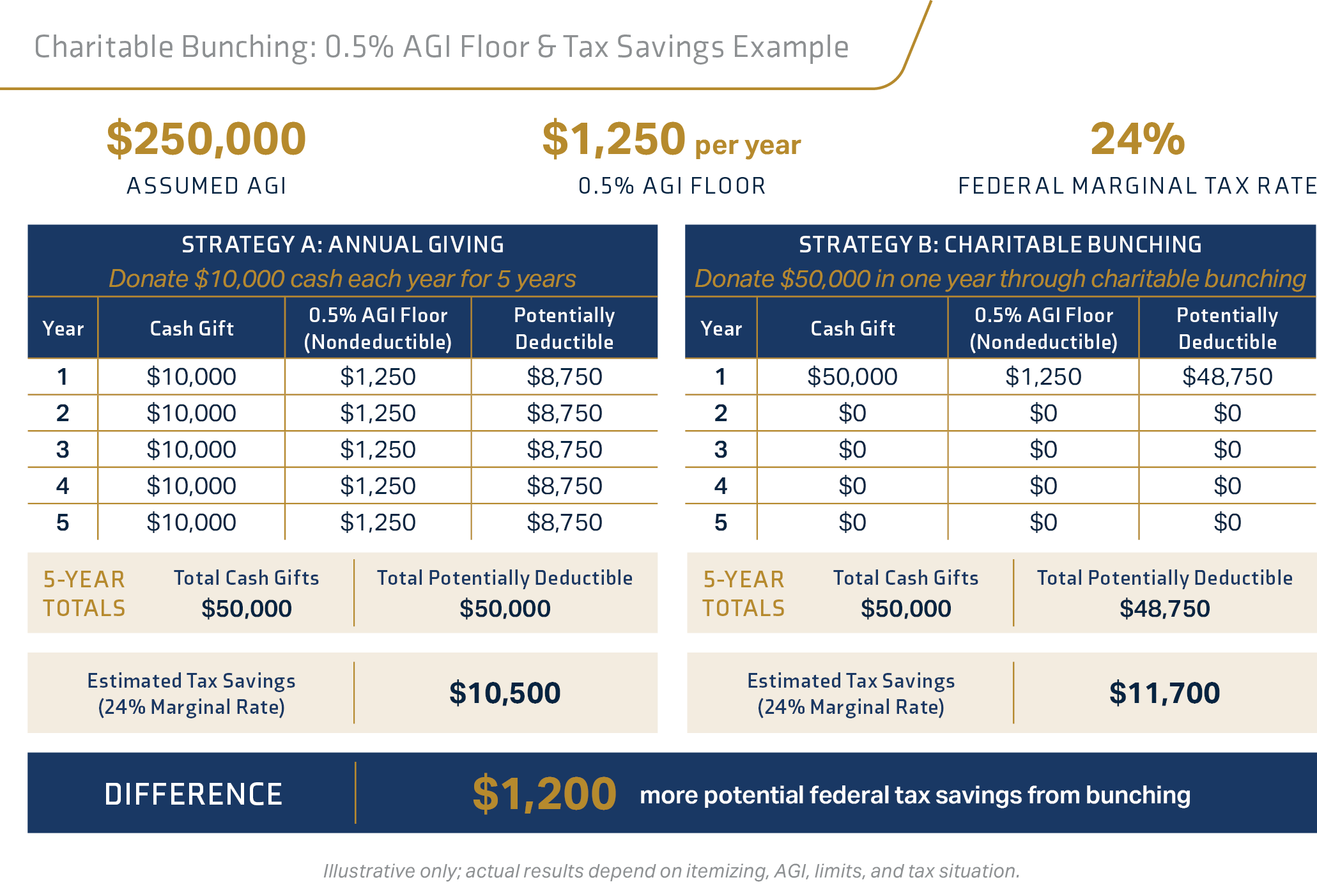
Bunching several years of charitable gifts into a single year, called “charitable bunching,” often through a donor-advised fund, may increase available charitable deductions while potentially still allowing grants to charities to be distributed over time.
For households holding investments that have increased in value, donating those investments instead of cash may help avoid recognizing capital gains while still supporting the intended charities.
QUALIFIED CHARITABLE DISTRIBUTIONS:
For individuals age 70½ and older, QCDs may provide a tax-efficient way to support charitable organizations directly from an IRA. A QCD allows you to donate directly from your IRA. A qualifying QCD can count toward the amount the IRS requires you to withdraw each year, known as a Required Minimum Distribution (RMD), while keeping the donated amount out of your taxable income.
NEW CHARITABLE DEDUCTION RULE:
Beginning in 2026, taxpayers who claim the standard deduction may be eligible to deduct a limited amount of qualifying cash gifts made directly to public charities. This provision may provide standard deduction filers with a way to receive a federal tax benefit for charitable gifts without having to itemize deductions.
The new rules may create additional tax‑planning considerations related to deductions, retirement income, charitable giving, and the timing of income. Your IMA Private Wealth advisor can work with you to evaluate how the new rules affect your income, deductions, charitable strategy, and retirement plan. Consider reviewing these opportunities before year-end, while there is still time to act.